


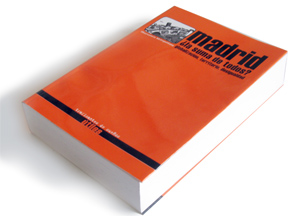
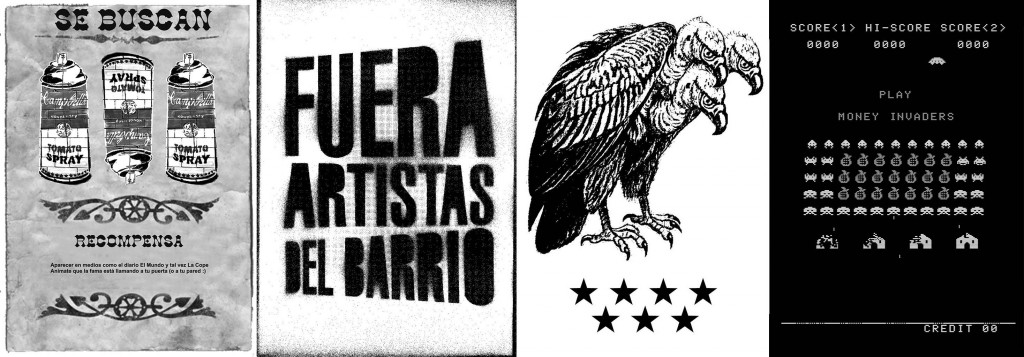


Hace un par de años comenzamos una pequeña (y todavía inconclusa) investigación sobre la operación de márketing urbano llevado a cabo por la empresa Triball y sus consecuencias en cuanto a la construcción física y social de la parte trasera de la Gran Vía en torno a la calle Ballesta.
Una primera aproximación al problema de este ejemplo de la así llamada “gentrificación” (aburguesamiento o pijización) fue un pequeño artículo escrito para “There Goes the Neighbourhood”, proyecto que trata del proceso de transformación del barrio de Redfern, en Sidney. El artículo tarta de explicar el proceso de mercatilización a través de la producción cultural lllevado a cabo en las calles de ballesta y aledaños, así como su posición dentro de las teorías canónicas de la gentriifcación.
Hemos subido a este blog una primera versión, más extendida que la que se publicó finalmente, dercargalá aquí:
La versión final del artículo se encuentra en el libro (también en inglés) que se puede descargar aquí:
http://www.theregoestheneighbourhood.org/TGTN-eBook.pdf:
The question of what kind of city we want cannot be divorced from that of what kind of social ties, relationship to nature, lifestyles, technologies and aesthetic values we desire. The right to the city is far more than the individual liberty to access urban resources: it is a right to change ourselves by changing the city. It is, moreover, a common rather than an individual right since this transformation inevitably depends upon the exercise of a collective power to reshape the processes of urbanization. The freedom to make and remake our cities and ourselves is, I want to argue, one of the most precious yet most neglected of our human rights – David Harvey, The Right to the City
There Goes the Neighbourhood was the ironic chorus to the 1992 Body Count song which lamented the invasion of the once poor (and Black) into the neighbourhood of the rich (and white). But an alternative destruction of “The Neighbourhood” can happen when the poor get pushed out of their local community as part of the process of gentrification. This issue is particularly relevant for the suburb of Redfern, an inner city suburb of Sydney which has been home for a large working class and Indigenous community, and which is undergoing a process of rapid development and change.
The Block, Redfern, has been described as the «Black Heart» of Australia and occupies a unique place within Sydney’s urban landscape as a centre for the Indigenous community. The suburb was once a strong working class neighbourhood and was the starting point for the 1917 general strike for a shorter working week – but in the 1980s the rail yards were closed down and have now been transformed into a new cultural centre, CarriageWorks. Redfern grabbed headlines in 2004 after riots erupted when a 17 year old Aboriginal boy died as he was chased by police cars on his push-bike. In that same year the Redfern/Waterloo Authority was established – a special government committee to oversee the rapid development and gentrification of the area. Redfern thus involves a complex, contested and controversial overlapping use of urban space.
There Goes The Neighbourhood is edited by Keg de Souza and Zanny Begg from You Are Here, a Sydney based art collective which focuses on social and spatial mapping.

abril 19th, 2017 at
Attractive section of content. I just stumbled upon your web site
and in accession capital to assert that I acquire actually enjoyed account your blog posts.
Any way I’ll be subscribing to your feeds and even I achievement you access consistently rapidly.
mayo 4th, 2017 at
My partner and I absolutely ove your blog and find almost all of your post’s to be just what
I’m looking for. can you offer guest writers to write content for yourself?
I wouldn’t mind producing a post orr elaborating on a few oof the subjects you write with regards to here.Again, awesome website!
septiembre 10th, 2017 at
This design is wicked! You certainly know how to keep a reader entertained.
Between your wit and your videos, I was almost moved to start my own blog (well, almost…HaHa!)
Fantastic job. I really loved what you had to
say, and more than that, how you presented
it. Too cool!
diciembre 11th, 2017 at
I’ve been surfing online more than 9 hours today for butable pendrive windows 7 starter
snpc oa downlod free & Observatorio Metropolitano > Blog Archive > Gentrificación en Madrid: El caso Triball y
TGTN, yet I never found any interesting article like yours.
It is pretty worth enough for me. In my opinion, if all webmasters and
bloggers made good content as you did, the web will be much more useful than ever before.
junio 13th, 2018 at
I’m more than happy to uncover this website. I want to to thank you for ones time
for this particularly wonderful read!! I definitely liked every bit of it and
I have you book-marked to look at new stuff on your site.
agosto 23rd, 2018 at
Awesome post.
febrero 18th, 2019 at
It’s amazing in support of me to have a website,
which is beneficial in favor of my experience. thanks admin
mayo 4th, 2019 at
Ableton
blog topic
junio 13th, 2019 at
I’d like to find out more? I’d love to find out some additional information.
junio 23rd, 2019 at
It’s amazing in support of me to have a web site, which is helpful designed for
my know-how. thanks admin
Feel free to surf too my blog; “MicroAlpha Neutralizers provide total EMF protection filtering harmful parts of EMFs so they become harmless.”